

AI content for online stores can shorten the time needed to prepare product descriptions, category copy, and helpful resources, but automation alone does not guarantee greater visibility. If hundreds of descriptions are created from one template, differ mainly in the product name, and repeat the same generic phrases, a store may gain more text without necessarily gaining more value.
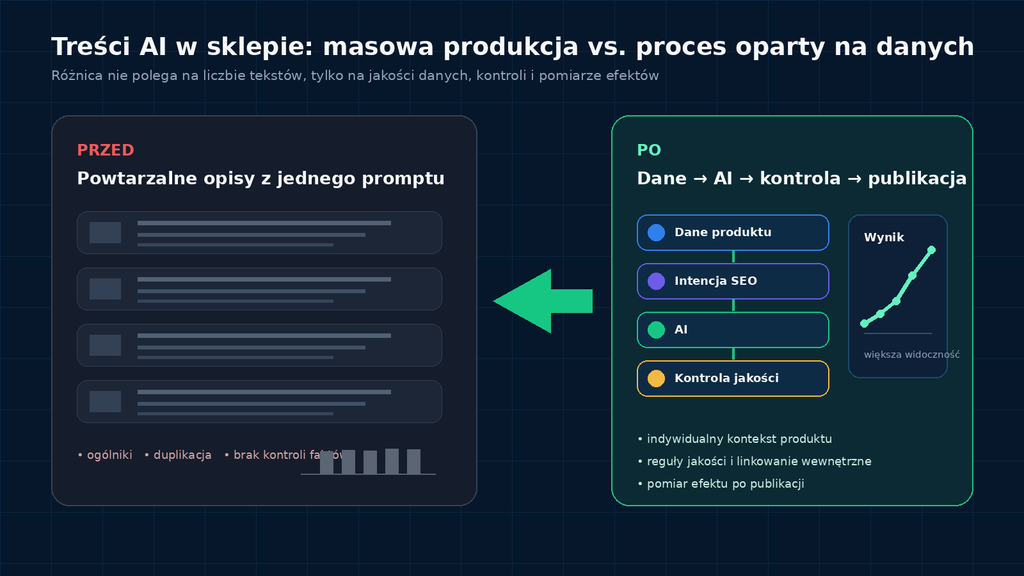
The best results appear when AI is part of the process, not its only component. SEO data identifies the topic and search intent, product information provides the facts, a language model helps prepare a draft, and quality rules verify accuracy and uniqueness. Only after this preparation is the content published and later evaluated based on rankings, traffic, and user behavior.
That is why content automation is worth combining with efforts to increase website visibility, rather than treating it as a separate process. Content is one of the signals that support SEO, but it must work together with the store’s structure, technical health, and internal linking.
AI Should Not Start with an Empty Prompt
The instruction “write an SEO product description for product X” is too general. The model does not know which information matters most to the customer, which features have been verified, how the product differs from other models, or which queries the page should answer.
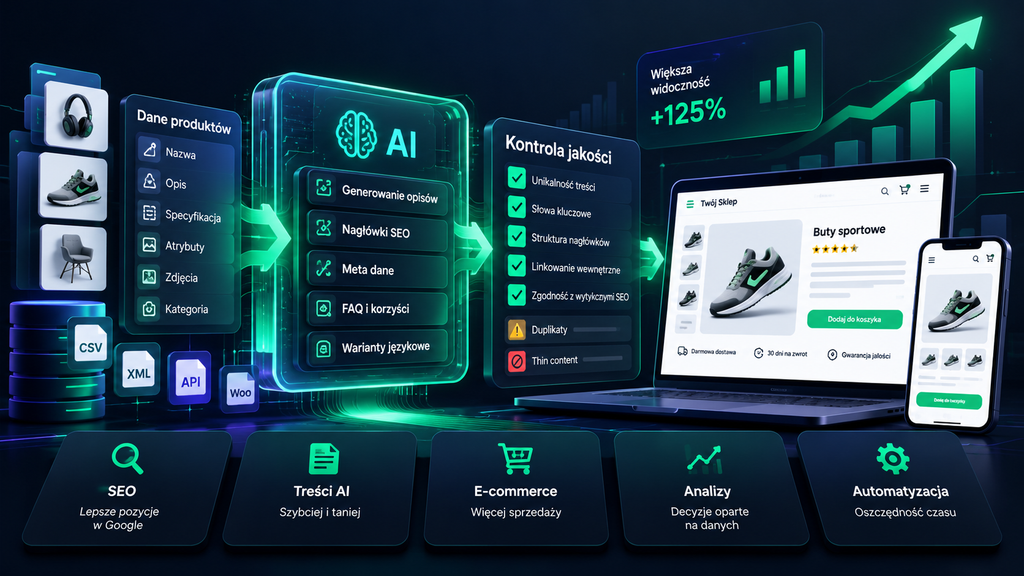
A better process starts with structured data. For a product, this may include its name, manufacturer, model, technical specifications, applications, materials, variants, compatibility, usage instructions, and limitations. For a category, we also need information about the product group, selection criteria, and user intent.
The better the input data, the less room there is for generic statements and errors. AI can then focus on structure, language, and combining the information into a clear description.
This is also important when scaling up. If a store has 5,000 products, creating every description manually from scratch is costly. However, if product data is well structured, you can build a process that prepares copy faster while preserving the individual characteristics of each product.
Product Descriptions and Category Descriptions Serve Different Purposes
One common mistake is generating every type of content according to the same template. A product page should answer questions about a specific model and help the user make a decision. A category page, on the other hand, should explain how to choose between a group of products and how the available solutions differ.
On a product page, important elements include features, applications, specifications, compatibility, usage instructions, and purchase arguments. On a category page, broader context matters more: product types, selection criteria, differences between variants, and answers to questions that arise before purchase.
AI should therefore use different templates and data sets. This helps avoid a situation in which every category begins with the same paragraph and product pages merely rewrite a specification table as full sentences.
How to Reduce Content Repetition in a Large Catalog
Repetition is a natural challenge in online stores, especially when products differ by only one parameter. There is no point pretending that twenty variants of the same device are completely different topics. However, you can ensure that every page provides its own value.
Instead of forcing artificial “uniqueness” into every sentence, focus on differences that matter to the customer. A higher-powered variant may be recommended for a different application. Another size may fit a different type of installation. A change in material may affect durability, weight, or cleaning requirements.
This is precisely the information that should be included in the generation context. If the model knows only the product name, it will produce generic sentences. If it receives the differences between variants, it can create content that genuinely helps users choose.
It is also worth introducing rules that block repetitive opening phrases, excessive superlatives, and information-free sentences. Automation should remove fluff, not produce it on a larger scale.
Keywords Are a Guide, Not a Checklist
Content created for SEO should not be a collection of keywords. Modern queries come in many variations, and users often do not type the exact category name. They search for a way to solve a problem, compare products, ask about applications, or look for specifications.
That is why a topic cluster is a better starting point than a single keyword. For a tools category, queries may relate to applications, materials, sizes, compatibility, and how to choose. The content should address these needs naturally.
In practice, the primary keyword helps define the topic, but the structure of headings and paragraphs should result from search intent. This makes the description useful even to users who reach the page through a longer, more specific query.
Automated Content Will Not Fix a Store’s Technical Problems
A store may have excellent descriptions and still fail to realize their potential if Google cannot properly index key pages. Problems with canonical tags, filters, pagination, noindex, duplicate URLs, or 404 errors can limit visibility regardless of content quality.
That is why it is worth checking the technical condition of the site before publishing content at scale. An online SEO audit helps identify structural and indexability issues before you generate hundreds of new texts for pages that should not or cannot appear in search results.
This is especially important for filters. If a store creates thousands of parameter combinations, not every one needs a description, and not every one should be indexed. Architecture must come first; content can be scaled afterward.
AI for Online Stores Should Use Multiple Data Sources
The best description is not created solely from a keyword. It is worth combining product data, manufacturer information, SEO data, and brand guidelines.
Product data provides the facts. Search analysis helps you understand the language customers use. Brand guidelines define the style. Competitor data may identify questions that should not be overlooked. Together, these sources create a much richer context than a single prompt.
In SEO BOOK OS, the AI module for online stores could ultimately serve precisely this purpose: content generation should be connected to system data rather than operate as an independent text generator. This would allow users to create descriptions in the same environment where they analyze visibility and the technical condition of their website.
Quality Control Before Publication
Automation is most useful when it follows clearly defined rules. Before publication, content should undergo checks for factual accuracy, repetition, readability, and consistency with the page type.
Check that AI has not added features the product does not have. Verify numerical values, sizes, materials, and compatibility. Remove claims that cannot be supported. In regulated industries, it is particularly important to review wording related to health, safety, or guaranteed results.
It is also worth defining a maximum number of similar phrases and prohibited expressions. If every description starts with “If you’re looking for high quality…”, the problem will become obvious as soon as more content is deployed.
A good practice is to generate content as drafts rather than publish everything immediately. Automatic publication can be the next step once the process and quality-control rules have been tested.
Internal Linking Can Be Created Alongside the Content
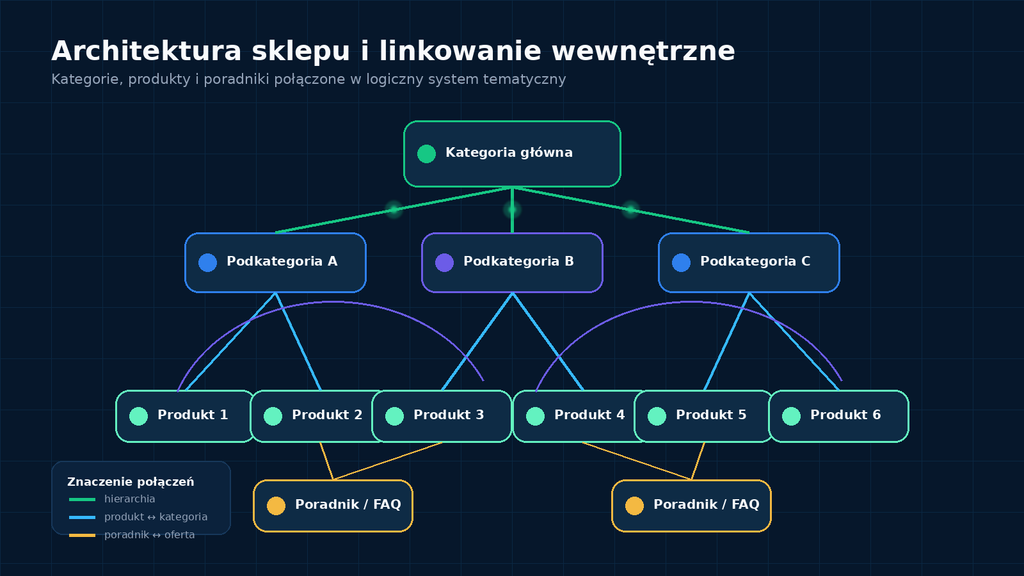
An online store has a natural structure: products belong to categories, categories belong to broader groups, and helpful resources explain problems related to the product range. AI can help identify places where an internal link would be useful to the reader.
This does not mean automatically inserting the same keyword into every description. A link should lead to a logical next step. An article about choosing a product can link to a category, a category description can link to a helpful guide, and a product page can link to content explaining how to use the product.
Well-designed internal linking helps users navigate the store while also showing search engines how topics are related. This is one area where automation can save considerable time without reducing quality.
Measure the Results, Not the Number of Texts Generated
The number of descriptions generated is a production metric, not a success metric. From an SEO perspective, what matters is whether pages gain visibility, appear for new keywords, and encourage users to continue browsing.
It is worth recording the date of publication or a major update and then monitoring ranking changes. This allows you to compare different content types and generation templates. If one approach consistently produces better results, it can be used across a larger part of the catalog.
The lack of results should be analyzed in the same way. If a description has been improved but the page still does not appear in search results, the problem may lie in indexing, internal URL competition, or insufficient internal linking.
Does Every Product Page Need a Long Description?
No. Length is not a goal in itself. A product with simple specifications may need a short, specific description, a data table, and a few answers to common questions. Expanding it to 2,000 words just to “make it SEO-friendly” may reduce usability.
Longer content makes sense when users genuinely need an explanation of the product’s applications, differences, installation method, compatibility, or other factors that influence the purchase.
AI makes it possible to adapt the length to the product type. You can define separate rules for simple products, complex devices, categories, and helpful resources. This is a better solution than using one template for the entire store.
AI Content Should Strengthen a Store’s Competitive Advantage, Not Blur It
If every store uses a similar generator and similar input data, the resulting content can easily sound alike. A competitive advantage emerges when you add knowledge that your competitors do not have.
This may include customer experiences, in-house testing, information from the technical team, sales representatives’ recommendations, photos showing products in use, model comparisons, or data from complaints and frequently asked questions.
AI can help organize this information and turn it into a clear structure. However, it does not replace the company’s own expertise. The more valuable data you provide, the harder it becomes to achieve the same result with a simple prompt.
Scale Content Only After Building a Strong Process
AI content for online stores can dramatically speed up the work, but the greatest benefit is not writing faster. It is the ability to create a repeatable process: data → intent → draft → review → publication → performance measurement.
This model allows you to gradually increase scale without losing control over quality. First, it is worth testing a dozen or several dozen pages, checking accuracy and results, and only then expanding content generation to additional product groups.
When automation is combined with rank tracking, technical audits, and internal linking, content stops being a separate element. It becomes part of a system for managing the store’s visibility.
This is the direction AI for e-commerce should take: less random generation, more data, quality rules, and measurable results.