
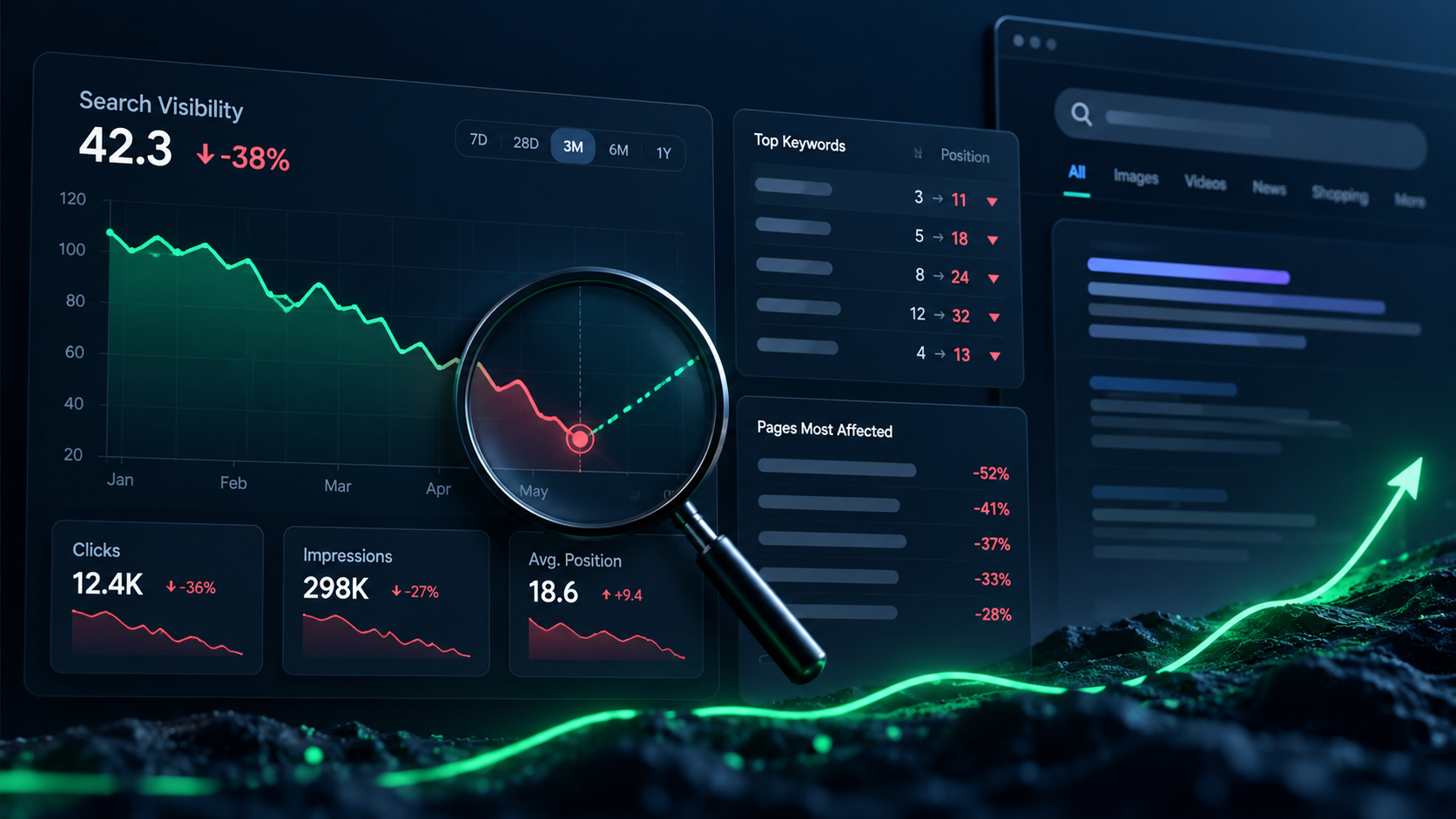
A drop in Google rankings rarely has one simple cause. In practice, visibility is affected simultaneously by the website’s technical condition, the quality and freshness of its content, changes in search results, competitor activity, internal linking, the external link profile, and the way Google reassesses individual pages. That is why a response such as “let’s add more text” or “let’s build a few links” often fails to solve the problem and can sometimes make later diagnosis more difficult.
A data-driven approach is much more effective. First, determine exactly what has dropped, then look for a common pattern, and only after that introduce changes. When SEO is managed this way, it is easier to distinguish temporary fluctuations from a genuine problem and avoid hasty changes that could harm pages that are still performing correctly.
In SEO BOOK OS, the starting point is a combination of rank tracking, SERP changes, and technical audit data. This approach is a strong complement to a strategy for increasing website visibility, because it enables decisions based on actual changes rather than a single ranking snapshot.
First, determine whether your visibility has really dropped
One keyword moving from position 4 to position 8 does not necessarily indicate a crisis. Search results change every day, and in some industries differences can be visible even within a few hours. The scale and consistency of the change are what matter.
Ask yourself a few questions. Does the drop affect one keyword, an entire group of keywords, or most of the project? Does the problem occur only on mobile devices? Has one page, the entire product catalog, a specific category, or the whole domain declined? Did the change happen suddenly, or did rankings gradually fall over several weeks?
These distinctions lead to completely different hypotheses. A sudden drop affecting many URLs may indicate a technical or indexing issue, or a major change to the website. A gradual decline affecting one content group is more often related to growing competition, outdated information, or a change in search intent.
The most useful tracking system is one that preserves historical data. It allows you to look beyond the “today” snapshot and compare rankings before and after changes were implemented. If the template, URLs, menu, or content were modified during the same period, the turning point is much easier to identify.

Check whether Google still sees the right page
A common source of problems is not content quality itself, but a change in the URL Google considers the best result for a given keyword. If a category page used to rank, but after changes a blog post or product page starts appearing instead, you may be dealing with topical dilution or competition between your own URLs.
Compare the historical and current URL assigned to the keyword. If the URLs have changed, check internal linking, headings, SEO titles, canonical tags, and content similarity. Two pages do not need to target the exact same keyword to compete for the same intent.
This is also important when expanding a blog. An informational article should answer the user’s question, while a service page should remain the destination for someone looking for a solution or tool. That is why the main topic of this article is diagnosing ranking drops, not general SEO or an audit offer. Service pages are simply a logical next step in the user journey.
Verify the technical causes of the drop
If the decline affects many URLs at once, technical analysis should be high on your checklist. Pay particular attention to errors that appear after a WordPress update, a theme change, the rollout of a new store version, a category structure modification, or a website migration.
Start by checking HTTP status codes, redirects, noindex tags, canonical tags, crawler access, URL indexability, the presence of pages in the XML sitemap, and links leading to 404 errors. On larger websites, checking these elements manually is inefficient. It is much faster to identify patterns by running an online SEO audit and comparing the errors with the list of pages that have lost rankings.
For example, if 80% of the URLs with the largest drops have canonical tags pointing to another page, you do not need several more weeks of content creation. The technical signal must be fixed first. The same applies to an accidental noindex, a redirect chain, or incorrect internal linking.
It is also important to determine whether the problem affects the entire website or a specific page type. If category pages are performing correctly while only blog posts are losing rankings, the cause is probably in the post template, linking structure, or content quality—not in the need to rebuild the entire website.
See what has changed in the search results themselves
A ranking drop does not always mean that the page has become worse. Sometimes Google simply changes how it presents answers. Search results may include additional boxes, videos, local results, shopping modules, or other content types that better match the current intent.
That is why you should check the SERPs for the keywords that have declined. Look at which domains have moved up and what they have in common. Are they guides? Product categories? Tools? Comparisons? Manufacturer pages? If articles dominated a month ago but service pages now make up most of the top 10, the problem may be a mismatch between the content format and the search intent.
Do not copy competitors mechanically, however. The purpose of the analysis is to understand the pattern, not recreate someone else’s page. If the best-performing materials contain examples, tables, and data, consider adding elements that improve the usefulness of your own content. If short answers are winning, adding another 5,000 characters may not help.

Assess the freshness and completeness of the content
Content may still be grammatically correct but no longer meet users’ needs. Articles about tools, prices, regulations, software features, and processes affected by technological changes become outdated particularly quickly.
When analyzing a drop, check when the text was last updated, whether it answers the user’s most important questions, and whether it provides a logical path to further resources. Also assess whether the page has been “diluted” by additions that stray from the main topic.
A proper update is not just a change to the publication date. It should include removing outdated sections, adding new examples, improving the heading structure, and strengthening internal linking. Sometimes shortening an article is more effective than expanding it.
Compare your page with competitors, but focus on differences that matter to users
Competitor analysis is valuable when it leads to specific conclusions. The fact that a competitor’s article has 2,500 words while yours has 1,600 does not mean much by itself. What matters more is whether the competitor solves the user’s problem better.
Check the content structure, topical coverage, visual elements, examples, data, comparison tables, FAQs, and the way the page guides users to the next step. Also see whether the page is supported by more internal links from other important pages on the domain.
On websites developed over several years, older content is often weakened precisely because it lacks internal links. New articles receive links from recent publications, while earlier materials gradually become more distant from the website’s main structure.
Do not fix everything at once
One of the biggest mistakes after noticing a drop is to introduce many changes at the same time: a new title, a new H1, a content overhaul, additional links, a URL change, and new external links. If rankings recover, you will not know what worked. If they fall even further, it will be equally difficult to identify the cause.
A phased plan is much better. First, remove critical errors that may block indexing or the transmission of signals. Then improve content alignment and internal linking. Only afterward should you assess the need for off-page actions.
Record the implementation date after every significant change. This turns your ranking history into an experiment log. After a few weeks, you can assess whether the change actually improved the situation.
How to set repair priorities
Not every ranking loss matters equally. If a keyword has limited business potential and improving it would require rebuilding an entire section of the website, it may not be the best first task. On the other hand, a drop affecting a page responsible for a significant share of traffic or sales requires a faster response.
A good prioritization model considers the scale of the drop, the number of keywords assigned to the URL, potential traffic, the page’s importance for conversions, and the difficulty of the fix. Sometimes a simple canonical or internal linking correction can deliver a greater impact than an expensive overhaul of a dozen articles.

What to monitor after implementing changes
Do not evaluate the result based on a single day after making a fix. Google needs time to revisit the page, process the content, and reassess signals. Depending on the website and the type of modification, the effect may be visible quickly or only after several weeks.
Above all, monitor the average direction of change for the entire keyword group rather than individual spikes. Check whether the correct URL is returning and whether new technical errors are appearing. It is also worth watching to ensure that improving one section has not created a conflict with another page.
If growth is stable, you can extend the next actions to similar URLs. In this way, an individual problem becomes a source of knowledge for the entire domain.
A drop in Google rankings is a signal to analyze, not panic
The greatest advantage in SEO is not the ability to react to every ranking change, but the ability to distinguish noise from a problem that requires action. Keyword history, SERP analysis, and the website’s technical condition should be assessed together.
Only after gathering this information should you decide whether you need a technical fix, a content update, an internal linking overhaul, or broader work on visibility. This approach limits random actions and enables you to develop the website in a more predictable way.
SEO is not a one-time optimization. It is a process of measurement, interpretation, and successive decisions. The better organized your data is, the easier it becomes to find the real cause of a drop and assess whether the changes you introduced actually produced results.